

If you've been seeing radiofrequency—or RF—everywhere in skincare lately, you're not imagining it.
Radiofrequency technology has been used in professional aesthetic treatments for years, particularly for people looking to improve the appearance of skin firmness, texture and fine lines.
But professional RF treatments can also mean expensive appointments and repeated trips to a med spa or dermatologist.
That's one of the reasons I became interested in a different category: needle-free, surface-electrode RF devices designed for at-home skincare.
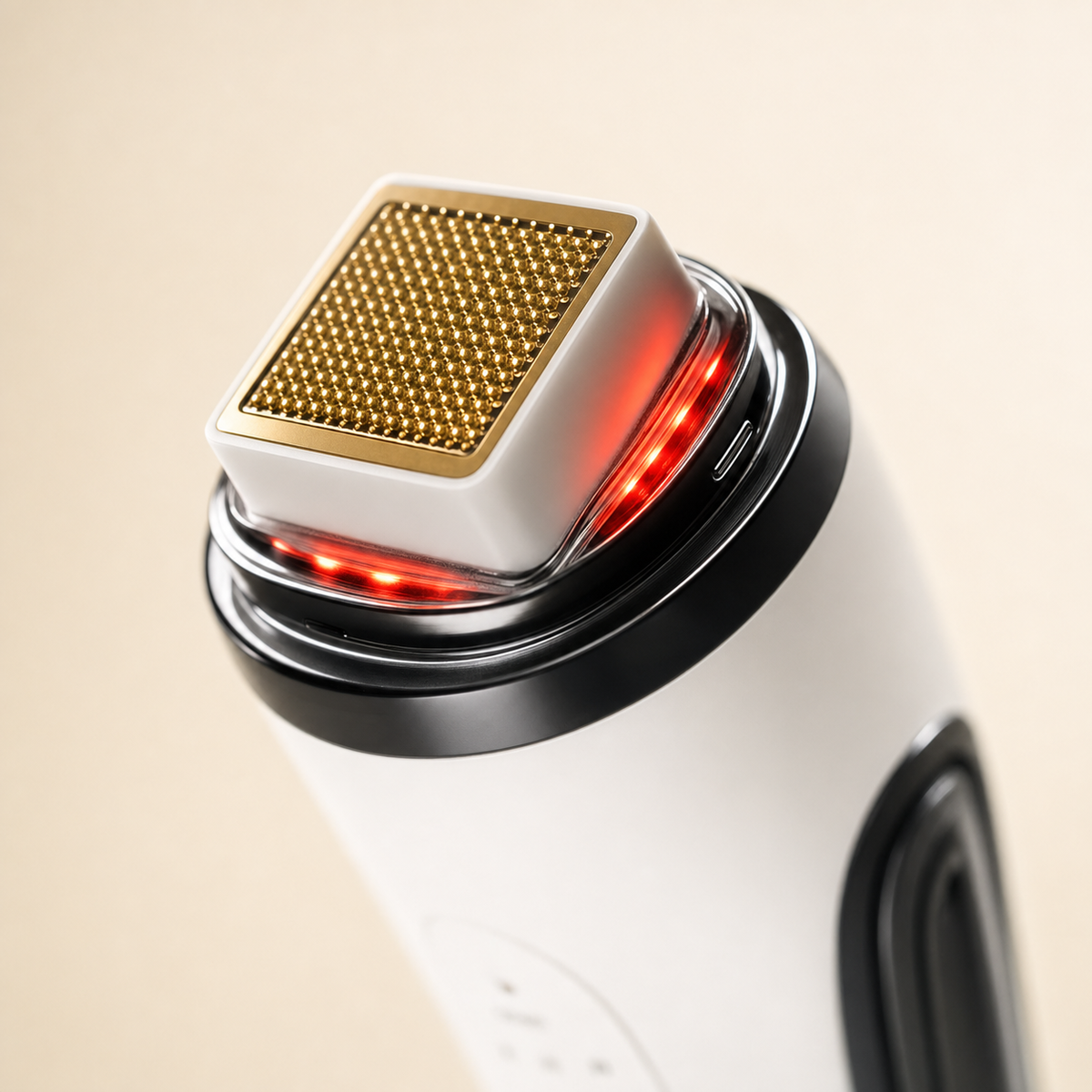
That's the technology behind the Redeem Dot™ 144-Point Dot Matrix RF Device.
So what exactly is Dot Matrix RF, how does radiofrequency interact with skin, and what does the research actually say?
Let's get into it.
First: What Is Radiofrequency Skincare?
Radiofrequency uses electrical energy to generate controlled thermal effects within tissue.
Unlike LED skincare devices, which use light, an RF device transfers radiofrequency energy through electrodes that contact the skin.
Controlled RF heating has been studied for its effects on collagen-rich tissue. Research on aesthetic RF treatments has reported changes consistent with new collagen and elastin formation, along with improvements in measures such as skin laxity and appearance.
That's why you'll often hear RF associated with:
- Firmer-looking skin
- Smoother-looking texture
- The appearance of fine lines
- Skin laxity
- Facial contouring and rejuvenation
But there's an important distinction here: RF is a category of technology, not one single treatment.
Professional RF machines and small at-home RF devices can differ substantially in power, electrode design, energy delivery and treatment protocols.
Research performed using a professional RF system therefore shouldn't automatically be interpreted as proof that every at-home RF device will produce identical results.
So What Is Dot Matrix RF?
Instead of relying on one large contact point, the Redeem Dot™ uses a treatment head containing 144 small surface electrodes arranged in a matrix.
Think of it almost like a grid.
Those individual contact points allow RF energy to be distributed across the treatment area while the device is moved over the skin.
And there's something very important to understand about those little dots:
They are not needles.
They are surface electrodes.
That brings us to one of the biggest sources of confusion surrounding RF skincare.
Dot Matrix RF Is NOT RF Microneedling
RF microneedling and the Redeem Dot are not the same thing.
RF microneedling uses actual needles that penetrate the skin and deliver RF energy at controlled depths.
The FDA considers RF microneedling a medical procedure and issued a safety communication in 2025 after reports of serious complications associated with certain uses of RF microneedling, including burns, scarring, fat loss, disfigurement and nerve damage. The FDA specifically states that RF microneedling should not be used at home.
Redeem Dot does not use needles.
Its 144 points are surface electrodes that remain on the surface of the skin.
That's why we describe it as:
144 POINTS. 1 MHz RF. ZERO NEEDLES.
What Does 1 MHz Mean?
The Redeem Dot uses 1 MHz radiofrequency technology.
MHz stands for megahertz and describes the frequency of the RF energy.
You'll sometimes see very specific claims online saying a certain RF frequency automatically penetrates to an exact depth in the skin.
It's more complicated than that.
How RF energy interacts with tissue depends on several factors beyond frequency alone, including electrode configuration, device power, tissue impedance, contact and the way the device delivers energy.
That's why I don't think it's responsible to tell you that 1 MHz automatically equals a specific number of millimeters of penetration.
What we can say is that 1 MHz falls within radiofrequency technology used in aesthetic applications, while the overall performance of a particular device depends on its complete design.
Why Does RF Make the Skin Feel Warm?
This is one of the fundamental differences between RF and many other skincare technologies.
RF energy creates controlled heating within tissue.
That warming sensation is expected.
But more heat is not automatically better.
Your goal shouldn't be to make your skin as hot as possible.
With an at-home device, the treatment should feel like controlled, comfortable warmth—not burning or pain.
If your skin feels excessively hot, painful or uncomfortable, stop treatment.
That's also why proper technique matters.
Why Do You Need Conductive Gel?
This isn't an optional skincare extra.
Use a water-based RF conductive gel when using the Redeem Dot.
The gel helps create consistent contact between the electrodes and your skin and allows the treatment head to move smoothly across the treatment area.
Without enough gel, the device can drag across the skin and contact can become inconsistent.
Apply a generous layer before treatment and add more if the device stops gliding easily.
How to Use Redeem Dot
We include a complete user guide with the device, but the basic routine is simple.
1. CLEANSE
Begin with clean skin.
Remove makeup, sunscreen, oils and skincare products from the treatment area.
2. APPLY CONDUCTIVE GEL
Apply a generous layer of water-based RF conductive gel.
3. START LOW
Begin with the lowest comfortable intensity, particularly during your first few sessions.
You can determine how your skin responds before considering a higher setting.
4. KEEP IT MOVING
Maintain full contact between the treatment head and your skin while moving the device in slow, controlled passes.
Don't park the RF head over one spot trying to generate more heat.
5. LISTEN TO YOUR SKIN
Comfortable warmth is expected.
Burning, sharp pain or excessive heat isn't.
6. HYDRATE
After your session, remove the conductive gel and follow with a simple, hydrating skincare routine.
Where Can I Use It?
Redeem Dot is designed for facial skincare areas where you want to support the appearance of firmer, smoother-looking skin.
Common areas may include the:
Cheeks • Jawline • Lower face • Forehead
Avoid using the device directly over the eyelids, mucosal surfaces, broken or infected skin, or the front-center portion of the neck over the thyroid area.
Always read the complete safety guide before your first treatment.
What Does the Research Say About Radiofrequency and Skin?
This is where I want to be particularly careful because skincare marketing can get ahead of the science.
There is published research supporting radiofrequency as an aesthetic technology.
A systematic review of RF treatments reported histological findings consistent with neocollagenesis and neoelastinogenesis—essentially the formation of new collagen and elastin—and found generally positive outcomes across the studies evaluated.
More recent reviews have also reported improvements in areas including skin firmness, texture and signs of facial aging following RF treatments.
That's encouraging.
But here's the part that's often missing from beauty-device marketing:
Those studies don't necessarily evaluate the Redeem Dot.
Many RF studies involve professional systems with different energy levels, electrode configurations and treatment protocols.
So when we reference RF research, we're explaining why radiofrequency is an interesting and established area of aesthetic research.
We're not telling you that a clinical trial performed using another RF machine proves that the Redeem Dot will produce exactly the same result.
I think consumers deserve to know the difference.
When Should I Expect Results?
This is another place where I'd rather set realistic expectations than promise an overnight transformation.
RF skincare should be thought of as part of a consistent skincare routine.
Your skin isn't going to suddenly produce years' worth of structural changes after one session.
Some people may notice temporary changes in how their skin looks or feels following use, while changes associated with skin remodeling would be expected to develop gradually.
Your results can also depend on age, skin condition, consistency and other individual factors.
Consistency beats intensity.
Turning the device all the way up or using it excessively isn't a shortcut.
At-Home RF vs. Professional RF
I don't think these should be positioned as identical treatments.
Professional RF systems can be considerably more powerful and are administered by trained providers.
That also comes with a professional-treatment price tag.
At-home RF serves a different purpose.
It gives you a way to incorporate radiofrequency technology into your regular skincare routine without scheduling another appointment every time you want to use it.
That's the category the Redeem Dot was designed for.
Professional-inspired RF technology, made for an at-home routine.
Who Should NOT Use RF?
There are situations where RF may not be appropriate.
Do not use the device if you have a pacemaker, implanted defibrillator or other active electronic implant.
You should also seek appropriate medical guidance before using RF if you:
- Are pregnant
- Have metal or electronic implants near the treatment area
- Have reduced heat sensation
- Have an active infection, open wound, significant irritation, rash or sunburn in the treatment area
- Recently underwent surgery or an aesthetic treatment such as laser treatment, a chemical peel, injectable filler or neuromodulator
- Have a medical condition that may make RF or heat-based treatments inappropriate
When you're unsure whether RF is appropriate for you, ask your healthcare professional before using it.
Ready to Add RF to Your Skincare Routine?
If you've been researching radiofrequency because you're looking for another way to support the appearance of firmer, smoother and more refreshed-looking skin, Redeem Dot makes RF technology much easier to incorporate at home.
Redeem Dot™ features:
144 surface RF electrodes
1 MHz radiofrequency technology
3 adjustable intensity levels
Completely needle-free
Cordless + rechargeable
Complete Redeem Recover User Guide
And because understanding how to use RF correctly matters, we've created a detailed guide covering conductive gel, technique, safety and proper device care.
Shop the Redeem Dot™ 144-Point Dot Matrix RF Device →
Important Note
This article is for educational purposes and isn't medical advice. Research discussed in this article examines radiofrequency technologies generally and/or professional RF systems and should not be interpreted as clinical testing of the Redeem Dot. Individual experiences and results vary. Follow the device instructions and consult an appropriate healthcare professional if you have questions about whether RF is suitable for you.


