

Hair thinning can be frustrating—and if you've looked into at-home options, you've probably seen everything from scalp serums and supplements to microneedling and red light therapy.
Red light therapy is one of the technologies I wanted to understand better before bringing it to Redeem Recover.
Not because red LEDs look impressive.
Because there's actually published research behind low-level light therapy (LLLT), also called photobiomodulation, for certain types of hair loss.
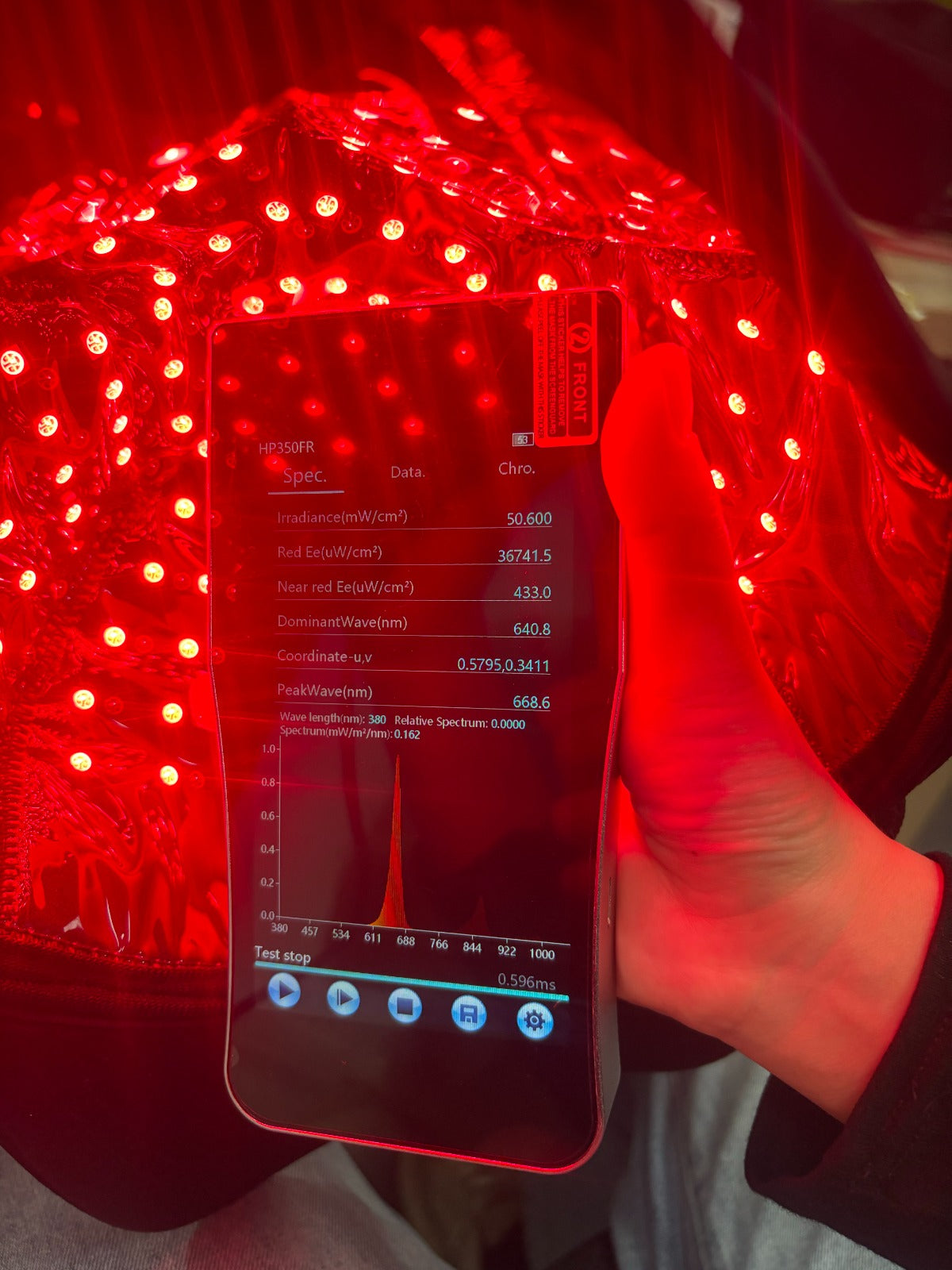
And when we sourced our own cap, I wanted to go a step further than simply trusting the wavelength printed on a supplier's specification sheet.
We tested a sample unit.
Here's what we learned, what the research actually says, and how the Redeem Recover Red Light Therapy Hair Cap can fit into an at-home hair and scalp-care routine.
SHOP THE REDEEM RECOVER RED LIGHT THERAPY HAIR CAP
What Is Red Light Therapy for Hair?
Red light therapy uses specific wavelengths of light rather than heat, chemicals or medications.
In hair research, you'll often see the terms low-level light therapy (LLLT), low-level laser therapy, LED therapy and photobiomodulation (PBM).
Researchers have investigated whether exposing the scalp to particular wavelengths of red or near-infrared light can influence biological processes associated with the hair follicle and hair-growth cycle.
The exact mechanisms are still being studied, but LLLT has now been evaluated in numerous clinical studies.
A systematic review and meta-analysis of randomized controlled trials found a statistically significant increase in hair density with LLLT compared with sham treatment in adults with androgenetic alopecia.
Importantly, benefits have been reported in both men and women and with different styles of light-therapy devices.
What Does the Research Actually Say?
This is where things get especially interesting.
The 655 nm Study in Women
One randomized, double-blind, sham-controlled study evaluated women with androgenetic alopecia using a device containing 655 nm red laser and LED light.
After the treatment period, researchers reported that the active-treatment group experienced a 37% greater increase in hair growth compared with the placebo/sham group.
That's a meaningful finding.
But there's an important distinction:
That study did not test the Redeem Recover cap.
It tested a different device using 655 nm light.
I'll explain why that wavelength became particularly interesting to us in a moment.
And It Isn't Just One Study
Research into LLLT for hair has continued to accumulate.
A large systematic review and meta-analysis published in Dermatologic Surgery included 38 studies and 3,098 patients.
Most participants had androgenetic alopecia.
The researchers found that hair density increased significantly in participants with androgenetic alopecia receiving LLLT compared with placebo and concluded that LLLT is a promising option for androgenetic alopecia.
They also noted that more research is needed to understand its effectiveness for other types of alopecia.
Other systematic reviews of randomized controlled trials have similarly reported evidence supporting LLLT for male and female pattern hair loss.
So this isn't about claiming that red light is a miracle treatment.
It's about recognizing that photobiomodulation has a legitimate and growing body of research behind it.
Then We Tested Our Own Cap
This is the part I was particularly excited about.
The Redeem Recover Red Light Therapy Hair Cap is manufacturer-specified to use:
660 nm red light + 850 nm near-infrared light
with a 1:2 ratio of 660 nm to 850 nm LEDs.
But a supplier specification and an actual measurement aren't quite the same thing.
So we tested a sample unit with light-measuring equipment.
Our sample measured:
50.6 mW/cm² measured irradiance
and
668.6 nm measured red-light peak
That second number immediately caught our attention.
Why Did 668.6 nm Catch Our Attention?
Remember the clinical study we just discussed?
It used 655 nm red light and reported a 37% greater increase in hair growth compared with sham treatment in women with androgenetic alopecia.
Our sample cap's measured red-light peak was:
668.6 nm
Those aren't identical wavelengths—and I don't want to pretend that they are.
But they both fall within the red portion of the spectrum, and the measurement gives us useful information about what our sample unit was actually producing.
That's an important distinction.
The clinical study doesn't mean the Redeem Recover cap will produce a 37% increase in hair growth.
Our cap was not the device used in that trial.
What the research tells us is that red light in this general wavelength range has been investigated clinically for hair growth.
What our test tells us is that a sample of our device produced a measurable red-light peak at 668.6 nm under the testing conditions used.
Those are two different pieces of information—and I think it's important to be transparent about the difference.
What Does 50.6 mW/cm² Mean?
This number is called irradiance.
Irradiance describes the amount of light power reaching a given area under particular measurement conditions and is commonly expressed in milliwatts per square centimeter (mW/cm²).
An easy way to think about it is:
Wavelength tells us what kind of light we're measuring.
Irradiance tells us how much light power was measured over an area.
Our tested sample measured approximately:
50.6 mW/cm²
under the conditions of the test.
That's much more useful to me than simply seeing a cap glow bright red.
What's Inside the Redeem Recover Cap?
Our current cap was selected to make photobiomodulation easy to incorporate into an at-home routine.
Specifications
150 LEDs
660 nm + 850 nm wavelengths*
Red + near-infrared light
1:2 LED ratio*
1 × 660 nm : 2 × 850 nm
50.6 mW/cm² measured irradiance†
668.6 nm measured red-light peak†
30-minute session timer
10 Hz + 40 Hz pulse modes
16W power consumption
Soft, lightweight cap design
*Manufacturer-provided specification.
†Measured from a sample unit under the testing conditions shown. Output measurements may vary with equipment, sensor placement, distance, angle, operating conditions and individual production unit.
Why We Chose a Soft Cap Instead of a Bulky Helmet
One of the things I've learned from trying different wellness devices is that a device doesn't help much if it's so inconvenient that you stop using it.
I wanted something you could actually incorporate into normal life.
Put the cap on.
Start your session.
Read.
Watch TV.
Answer emails.
Relax.
Then you're done.
The soft design is lightweight and wearable rather than making your hair-care routine feel like another appointment.
Consistency matters with photobiomodulation, so convenience isn't just cosmetic—it can make it easier to stick with a routine.
How Do You Use the Red Light Cap?
Follow the instructions supplied with your device.
For the Redeem Recover cap, a session is designed to be straightforward:
1. Start with a clean, dry scalp and hair.
2. Position the cap comfortably so the light-emitting surface sits close to the scalp.
3. Turn on the device.
4. Select the appropriate operating mode.
5. Allow the programmed session to run.
6. Remove the cap when the session is complete.
You don't need to apply conductive gel, oils or serums for the light itself to work.
In fact, putting heavy products on the hair or scalp immediately before treatment may affect how much light reaches the scalp.
And that brings us to another part of the hair-care routine.
What About Scalp Serums?
Use Them After Your Red Light Session
If a scalp serum is already part of your hair-care routine, you don't necessarily have to choose between topical scalp care and red light therapy.
The timing is what matters.
I recommend using the Redeem Recover Red Light Therapy Hair Cap on a clean, dry scalp before applying leave-in products.
Then, after your red-light session, you can move on to your topical scalp-care routine.
For customers who want to add that second step, we now offer:
Redeem Recover GHK-Cu Copper Peptide Hair & Scalp Serum
SHOP THE GHK-CU COPPER PEPTIDE HAIR & SCALP SERUM
The 60 mL GHK-Cu Copper Peptide Hair & Scalp Serum is a lightweight, non-greasy spray formulated for topical scalp and hair care.
Think of the routine as two separate steps:
STEP 1 — RED LIGHT
Start with a clean, dry scalp and complete your Redeem Recover Red Light Therapy Hair Cap session.
STEP 2 — SCALP CARE
After the session, apply the GHK-Cu Copper Peptide Hair & Scalp Serum to the scalp and gently massage it in with clean fingertips.
RED LIGHT → SCALP CARE
Simple.
Why GHK-Cu?
GHK-Cu is a naturally occurring copper-binding peptide composed of the tripeptide glycyl-L-histidyl-L-lysine bound to copper.
Copper peptides have become increasingly popular in cosmetic skincare and hair-care formulations.
And just as I'm careful about the research surrounding red light, I want to be careful here too.
We're not claiming that our GHK-Cu serum is a clinically proven hair-growth treatment.
Research into copper peptides is interesting, but that isn't the same thing as having a clinical trial demonstrating that this particular cosmetic serum regrows hair.
Instead, I see it as the topical scalp-care component of a broader hair-care routine.
The red-light cap provides the photobiomodulation component.
The GHK-Cu serum provides the topical scalp and hair-care component.
Two different approaches with two different purposes.
How Often Should You Use the Red Light Cap?
This is one area where I don't want to invent a treatment protocol based simply on what another clinical study did.
Different LLLT studies have used different devices, doses, treatment durations and schedules.
For example, the 655 nm female study followed participants over 16 weeks, while broader reviews have evaluated treatment periods ranging from several weeks to several months.
Follow the treatment schedule supplied with your Redeem Recover device rather than assuming that using it more frequently will produce faster results.
More isn't automatically better.
Consistency with the recommended routine is the goal.
How Quickly Does Red Light Therapy Work for Hair?
Hair grows slowly.
That's probably the most important expectation to establish.
This isn't the kind of technology where you should expect to use it tonight and wake up with visibly thicker hair next week.
Clinical LLLT research generally evaluates changes over weeks to months, not days.
If you're incorporating photobiomodulation into your routine, think in terms of:
Consistency over time.
Who Should Talk to a Healthcare Professional Before Using It?
Photobiomodulation is non-invasive, but that doesn't mean every device is appropriate for every person.
Check with an appropriate healthcare professional before using a red-light cap if you:
- Have a medical condition affecting your scalp
- Take medications that cause photosensitivity
- Have known light sensitivity
- Have unexplained hair loss
- Have recently undergone a scalp procedure or surgery
You should also follow all manufacturer safety instructions and discontinue use if you experience an unexpected reaction.
Why We Show You Our Actual Test
You can find hundreds of red-light devices online.
And almost all of them have impressive-looking specifications.
660 nm.
850 nm.
High power.
Professional technology.
But I wanted to know something much simpler:
What's actually coming out of ours?
That's why we measured a sample.
Our test showed:
50.6 mW/cm²
Measured irradiance
668.6 nm
Measured red-light peak
Those numbers don't guarantee a particular hair-growth result.
But they give us something much more meaningful than a photograph of glowing LEDs:
Actual measured information about a sample of the device we're selling.
And that's the kind of transparency I want Redeem Recover to be known for.
Build Your At-Home Hair & Scalp Routine
If you've been curious about photobiomodulation for hair but want something you can actually incorporate into your routine at home, we've created a simple two-step approach.
STEP 1: RED LIGHT THERAPY
Start with a clean, dry scalp and complete your Redeem Recover Red Light Therapy Hair Cap session.
The cap features:
150 LEDs
660 + 850 nm manufacturer-specified wavelengths
50.6 mW/cm² measured sample irradiance
668.6 nm measured sample red-light peak
30-minute sessions
10 Hz + 40 Hz pulse modes
SHOP THE REDEEM RECOVER RED LIGHT THERAPY HAIR CAP
SHOP THE RED LIGHT THERAPY HAIR CAPSTEP 2: COPPER PEPTIDE SCALP CARE
After your red-light session, follow with the Redeem Recover GHK-Cu Copper Peptide Hair & Scalp Serum.
Apply the lightweight spray to the scalp and gently massage it in with clean fingertips as your topical scalp-care step.
SHOP THE GHK-CU COPPER PEPTIDE HAIR & SCALP SERUM
RED LIGHT → SCALP CARE
Two different approaches. One simple at-home routine.
A Note From the Founder
I've looked at a lot of wellness devices.
One thing I've learned is that it's very easy to put impressive specifications on a product page. It's much harder for the person buying the product to know what those numbers actually mean.
That's why I wanted to do something a little differently with this cap.
We looked at the research.
We looked at the wavelengths being studied.
And then we actually measured a sample of our own device.
I don't want to promise you that a cap—or a serum—will magically transform your hair.
I want to give you access to interesting wellness technologies and ingredients, explain the research behind them, and be transparent about what we know and what we don't.
Because taking care of yourself shouldn't require falling for exaggerated claims.
— Lauren
Founder, Redeem Recover
Important Research & Testing Note
This article is educational and isn't medical advice.
The clinical studies discussed above evaluated low-level light/laser therapy devices that are different from the Redeem Recover cap. Their results should not be interpreted as clinical results for this product.
The 50.6 mW/cm² irradiance and 668.6 nm red-light peak are measurements from a sample unit under specific testing conditions and are not guaranteed measurements at every point on the scalp or from every production unit. Measurements can vary according to equipment, position, distance, angle and operating conditions.
The cap's 660 nm + 850 nm wavelengths and 1:2 LED ratio are manufacturer specifications.
The Redeem Recover GHK-Cu Copper Peptide Hair & Scalp Serum is a cosmetic hair and scalp-care product. References to GHK-Cu or copper peptides should not be interpreted as evidence that this particular serum has been clinically demonstrated to treat hair loss or regrow hair.
Individual results vary. If you're concerned about hair loss or have a medical condition, consult an appropriate healthcare professional.
Research Referenced in This Article
Systematic Review & Meta-Analysis — 38 Studies / 3,098 Patients
https://pubmed.ncbi.nlm.nih.gov/39404126/
Randomized Controlled Trial — 655 nm LLLT in Women
https://pubmed.ncbi.nlm.nih.gov/25124964/
Randomized Controlled Trial — LLLT in Men
https://pubmed.ncbi.nlm.nih.gov/24078483/
Systematic Review & Meta-Analysis of LLLT for Hair Growth
https://pubmed.ncbi.nlm.nih.gov/31746251/
2022 Systematic Review & Meta-Analysis
https://pubmed.ncbi.nlm.nih.gov/35510860/
Helmet-Type LLLT Randomized Controlled Trial


